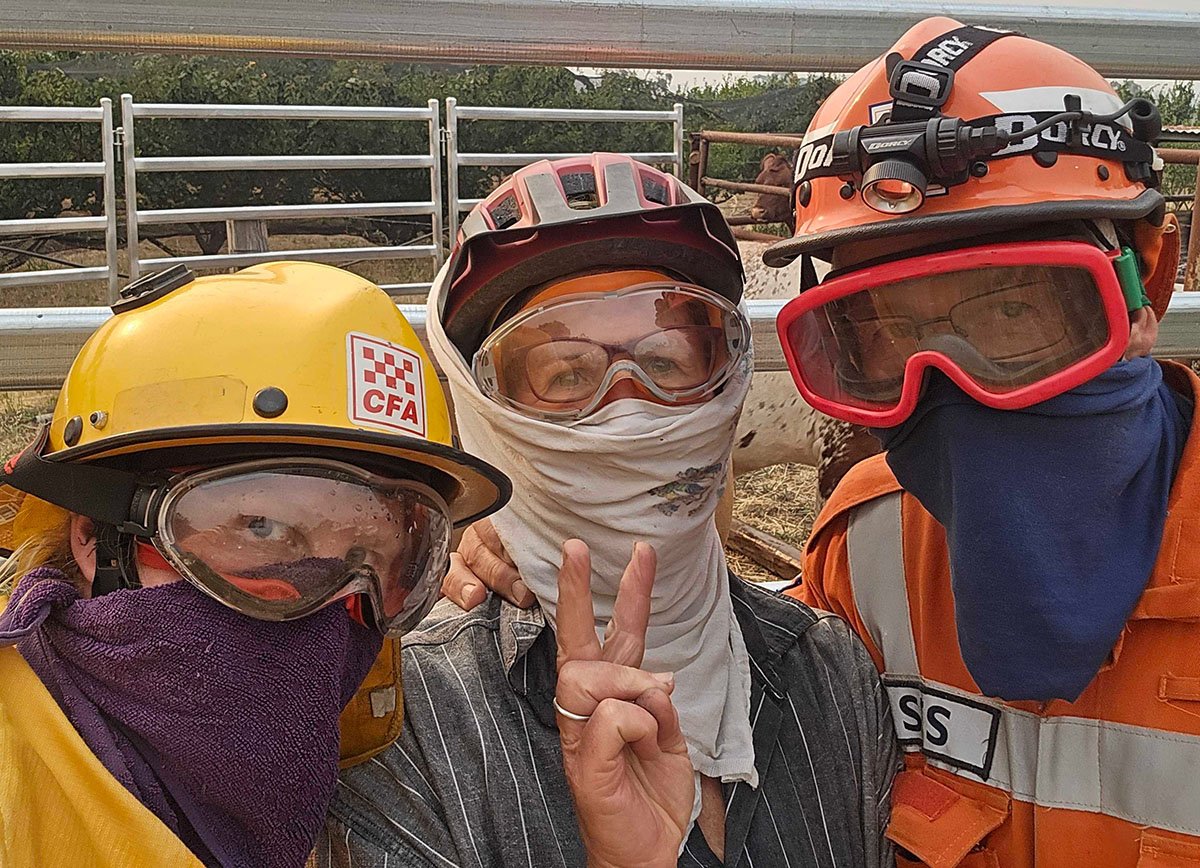

Thanks to everyone who has reached out to check on us; the humans, cows and farm are all exhausted but okay. We were ridiculously lucky. The fire which started on Friday 9 January and became known as the Fogartys Gap/Ravenswood fire was a text-book, worst case scenario for us at the farm.
Yet somehow, by virtue of being in the shadow of the Harcourt township, our farm has currently, miraculously it feels, remained unburnt. Many others in Harcourt and surrounds have not been so lucky. That Friday afternoon, Harcourt lost 54 houses, the Harcourt Cooperative Cool Stores, housing some 85 businesses, and the Coolstore cafe. Not to mention sheds, animals, wildlife, trees, fences, and pasture. The people affected in our fire and others, have been front of mind for us since it happened.

Our fire plan
We’ve been evolving our fire plan for years now. There are certainly things we wish we’d done better, like cut more grass in the lead-up. However, overall, we were really happy with how we worked together on the day.
As soon as we knew the catastrophic day was declared, we closed the farm to everyone other than our stay-and-defend crew of Katie, Hugh, and Tess. At 10 am, we met to talk about the day and decided to start enacting our plan by turning on the pump, some orchard irrigation blocks, the misters on the shed and a sprinkler in the stock yards.

This meant that by the time the Ravenswood fire started, things were already quite wet. Tess preemptively set up extra stock yards and fencing, ready to get the milkers in if needed.

When the Vic Emergency app went off, we quickly jumped into action. Grateful for the preparation we’d already done, Tess was able to get help from Katie and Hugh bringing the milkers and heifers into the stock yards.
She dropped all gates in the picnic gully block for the dry herd to have more space, but had to make the decision that they would have to fend for themselves.
Tess then stayed with the herd, hosing the space down, staying in constant communication with our farm crew who were metres away at the sheds and also with others offsite.
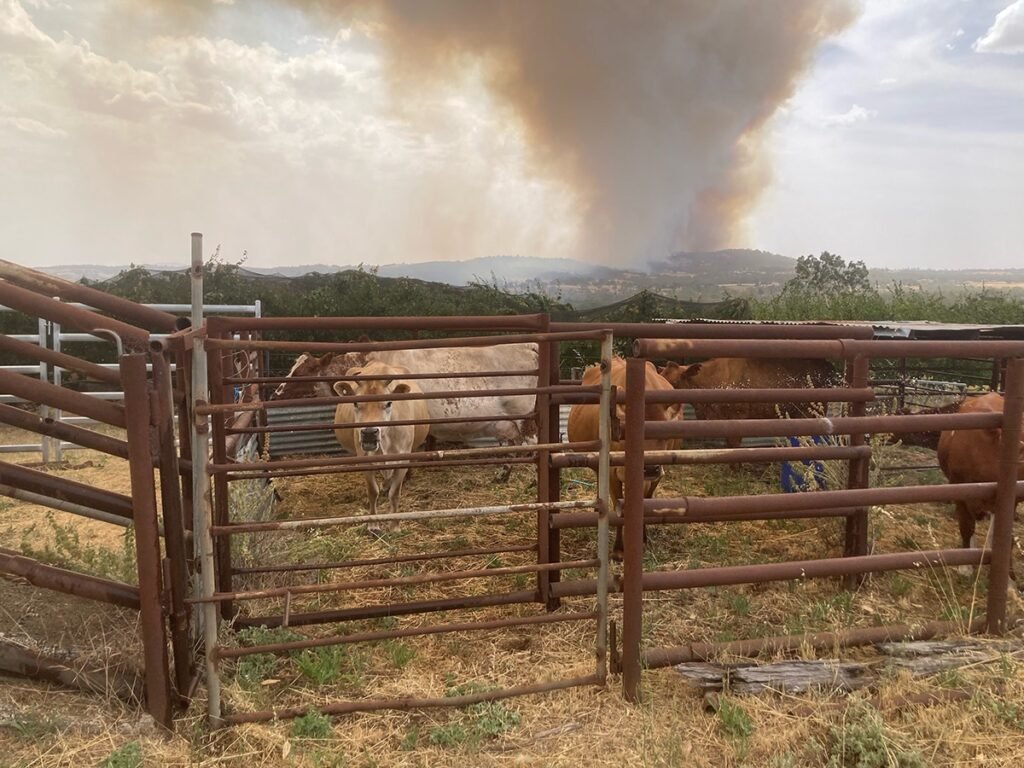
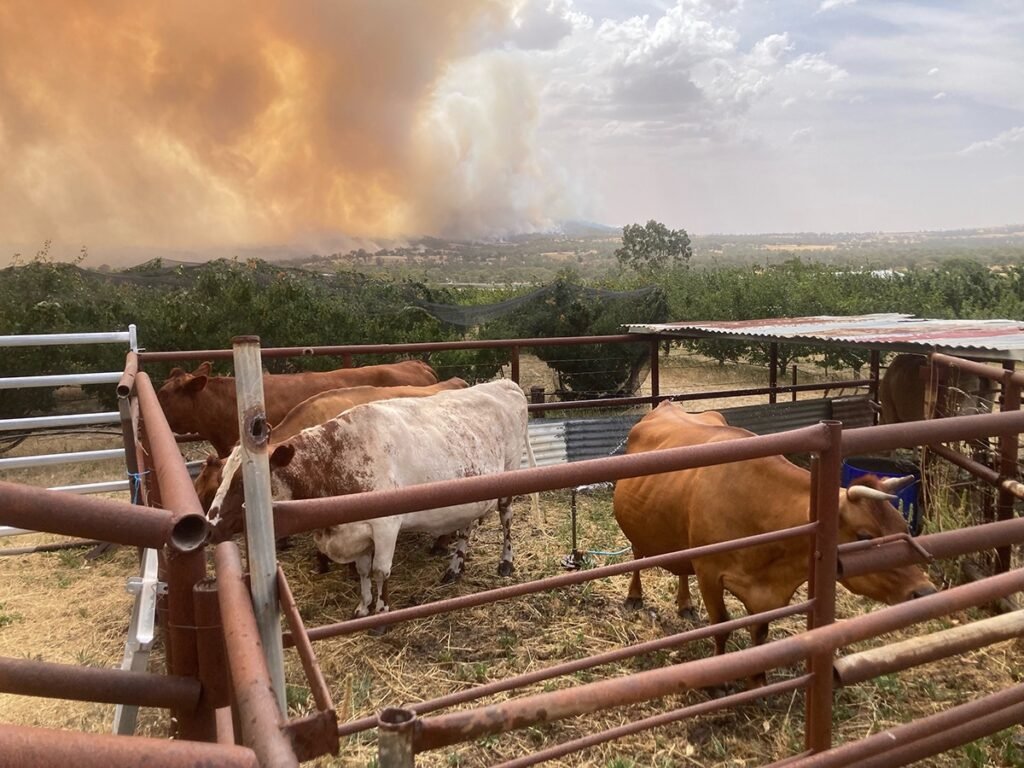
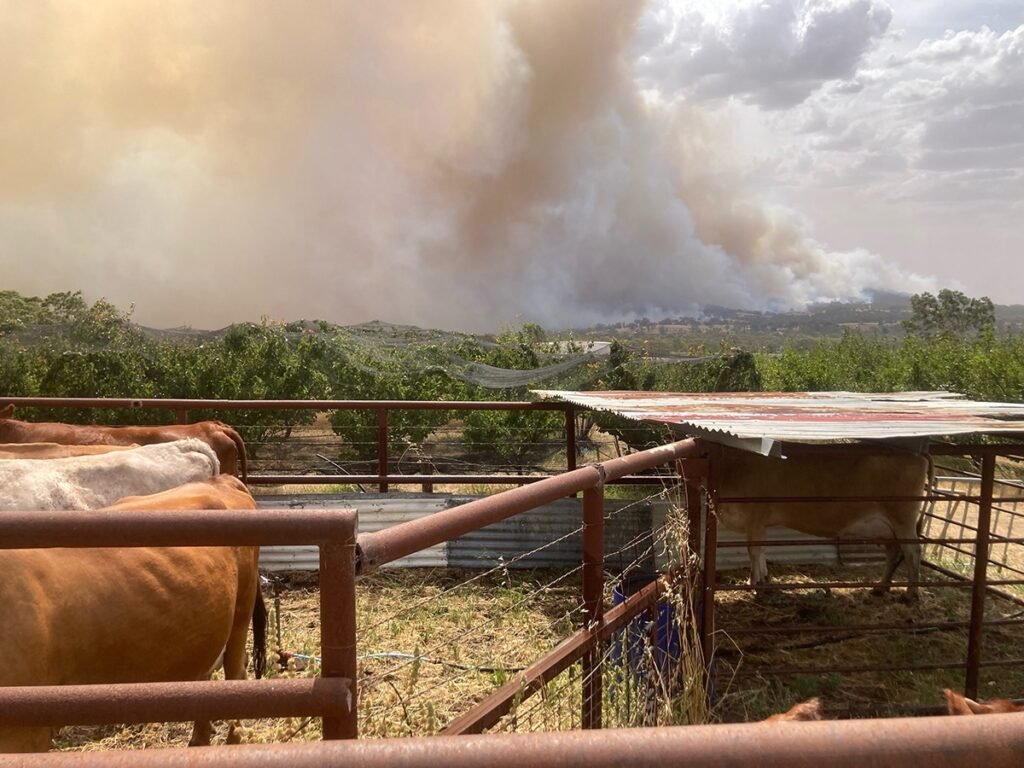
We watched the fire build and build as it raced down the valley. Then the predicted south-westerly wind change happened, and the long tongue became the wide fire front.
What we hadn’t anticipated was that at this point, the smoke was so thick we couldn’t see where the fire was. Was it about to race up the gully? We could only wait.
We planned that when the front approached, we’d retreat to a space between the metal shed and the water tank saturated with the misters, opposite the fire front. On this day, thankfully, we never reached that point.
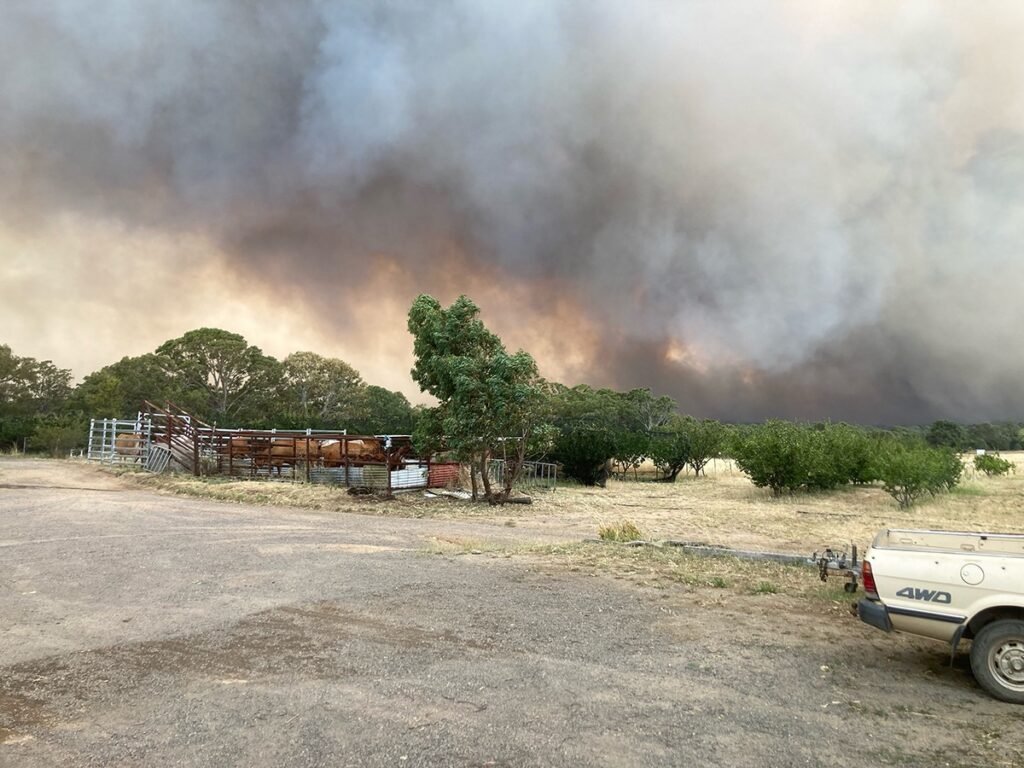
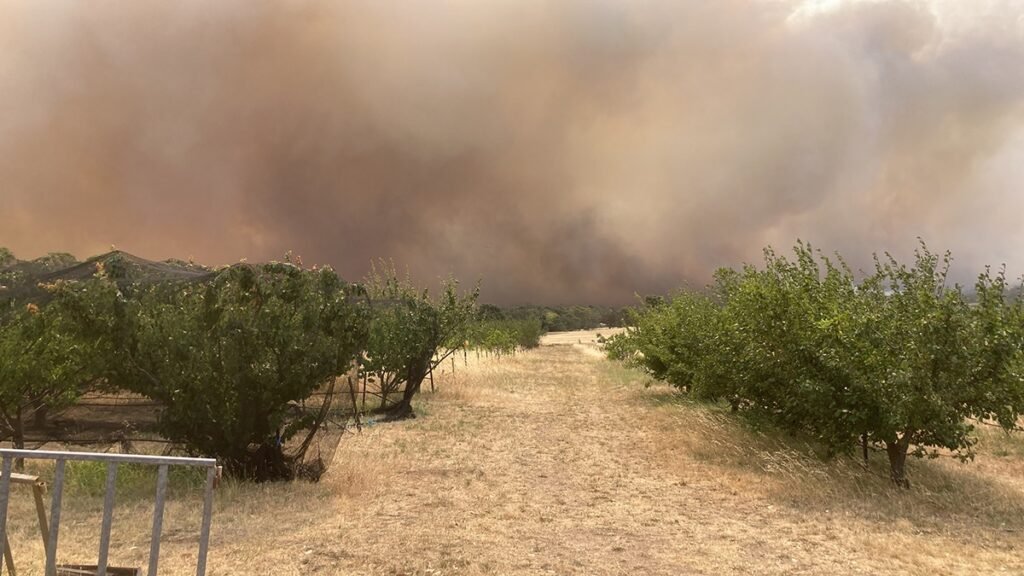
As the hours passed, we gradually got more understanding about the fire’s progress, finally able to see the valley again as the smoke cleared and the fire took off up the mountain.
With some relief but also terrible trepidation for what had happened in town, we realised the fire front had gone around us. For three nights, we took shifts watching as Liyanganuk burned.


What to do with all the milk
As the immediate fire danger decreased, our minds moved into logistics. We had no power and would likely not have for days, as many power poles lay in pieces on the ground.
Tess decided straight-up to announce there would be no dairy for a week. Without power overnight, all the dairy she had already bottled got too warm to sell. While she could still milk the cows, she had no ability to chill and process milk until the power returned. She needed to manage her energy, recover, stay alert in case the fire came back, and focus on the necessities of feeding cows, milking cows, sleeping, and eating.
The morning after the fire, Tess delivered every drop of milk from the farm in the refrigerated Hilux to her dear friend Lydia, who had power in Castlemaine. (Lydia just had her first shift working with us this week – yippee!) Lydia ran a cheese-making production line at home for days, filling Tess’s freezer with enough halloumi and fresh cheese to last a lifetime!

We were so shocked at how quickly agencies got to work restoring services, and — nothing short of a miracle — the power was restored on Monday night, and Tess was able to get back into production almost straight away, which was a surreal feeling for her.
Ongoing fire risk
Three days after the fire started, we had another adrenaline-fueled day as fire crews feared the south-easterly winds predicted for that night could push the fire back down from the mount and onto us.
As the public and Harcourt began their post-fire recovery, we were looking high risk again.
Fire crews from the CFA and FFMV worked tirelessly, water bombing, patrolling, dropping fire retardant lines from planes, back-burning, front-burning, and driving a big D6 dozer straight through the back of our property, creating a fire break. We (temporarily) have our own private road from the oak forest through to Faraday.

Each night, we walked up to our ridge line to see where they had burnt. All their work has paid off; the fire did not come back down from the mount.
While we won’t call the fire ‘out’ until we get our first big dump of rain (hopefully slow-falling to minimise erosion of all the burnt landscape), we are currently calling ourselves very bloody lucky.

The cows were amazing
Throughout all this, the cows were amazing. They remained calm, ruminating in the yards. On our second night of fire threat, Tess managed to get every cow on the farm into the yards.
In three separate sections, she had the young heifers, the dry cows, including Teddy, and the milking herd. They weren’t too happy about spending the night there, but she wasn’t taking the risk.
Teddy, on the other hand, loved every minute of it, having ALL his girls with him! He was chuffed and sad to part ways the next morning.

The impact on our community
Though the fire didn’t burn the farm, unfortunately, not all our coop members were so lucky. Liz (Katie’s sister, who runs Carr’s Fruit Tree Nursery with her) and her partner, David, sadly lost their house and almost everything else on their property, including some of their animals. Their niece was also living with them in a separate apartment, and she also lost everything.
People ask us (and them) how they are, and it’s hard to find the right answer. They’re resilient, tough, grieving, getting on with life, finding silver linings, exhausted, grateful, deeply sad, anxious, and sometimes excited about the future. Fair to say, it’s a deep and complex experience that will probably continue to unfold for years.
We’ve been very grateful that we have plenty of space and were able to offer them a home immediately. There’s a lot of help and support available, and plans are in place for longer-term secure housing options for both of them. It feels important for them to be able to stay in the community while they rebuild.
Thank you
Throughout this whole experience, we have been absolutely overwhelmed by the support we have received, often making us feel more emotional than the fire itself.
We’ve had so many people reaching out, sending us love and best wishes, and offering support. We’ve enjoyed so much delicious food that’s been made for us with love! There are too many to name them all, but Fiona, Sas, Duang, and Lizzie’s support crew get a special mention for the amazing meals they delivered.
- Oli came up with power miracles and shared the overnight watch shifts.
- Troy and Gordo helped with everything from whippersnipping to fruit deliveries.
- Fiona delivered a mobile coolroom to keep the Orchard Keepers’ fruit cool and stop it from rotting, and she and Ben gave Liz and the crew excellent care for a night when they had to evacuate again from the farm.
- SES delivered two generators the morning after the fire.
- Fruit Crew were amazing keeping the orchard ticking over.
- The Grow Great Fruit team have been understanding and patient with all our postponements.
- We received very welcome frozen meals from Castlemaine Church of Christ and many others – to be honest, we didn’t always know who they came from, so deep apologies if we’ve missed anyone.
Just a couple of days after the fire, the first fundraiser was held in Castlemaine, and at the same time the whole Harcourt community was invited for a free lunch at the Victorian Miniature Railway. It was a cathartic and very heartwarming experience to connect with friends and neighbours, share hugs and tears, and start to hear people’s stories.
Daily lunches at VMR continued for a few days, and then shifted to the Harcourt Leisure Centre supported by the Harcourt Progress Association, Castlemaine Community House, local pollie Maree Edwards, and every agency you can think of! These daily shared meals have been a lifeline, and we’re beyond grateful for all the organisations and individuals who have made it happen.
We’ve seen lots of speculation over what has happened, could have happened, should have happened. We’ve asked people not to speculate and to be careful about not accidentally spreading misinformation, because rumours spread like wildfire and they’re often not true!
But we’ve also seen community and friendships unite and strengthen, and we’re feeling more part of this community than ever before, and so grateful for everything that has been done to help us. A huge thank you to our amazing community!!!
How can you help?
Donations
At these times, there is an outpouring of people wanting to help in some way, and it’s important to make sure all that goodwill gets to where it’s actually needed.
There are lots of specific and worthwhile projects asking for donations, such as BlazeAid, but for a general way to help people affected by the Harcourt fires, we are asking people to connect with the Harcourt Progress Association who are overseeing much of the support.
Connect with CFA
At the start of every fire season, every CFA brigade offers a free community awareness session. PLEASE ATTEND.
One of the best strategies moving forward in a changing climate is for people to have a better understanding of fire behavior and how they can better prepare for it. Knowledge is power. We can’t advocate enough for attending these events annually, if possible. These sessions provide such a valuable resource and are usually under-attended.
We also highly recommend becoming a CFA member if you have the capacity. Our CFA is one of the most inspiring organisations and a model we will surely need to extend as a necessity in the future.
Thousands of people volunteer their time to help the community simply because they care. In our changing climate, we are going to need more people to be active in this way. If you are at all interested, connect with your local brigade.
Community preparedness
In a changing climate, we need to be fighting for change at all levels. One of the most important ways is through household and community preparedness for natural disasters. We can’t keep hoping it will never happen to us and assume that someone else will come to save the day. When it comes to fires, we all need to have a clear, realistic fire plan, which we stick to and continuously improve upon.
On days of catastrophic fire danger, we need to spend the day at the place we will be sheltering, not on the road. Firstly, being in a car on the road is the most dangerous place to be in a bushfire, and secondl,y it compromises emergency services’ ability to get to where they need to be. Before the fire day, this may feel inconvenient. On the day, it is literally vital.
Our Coop learnings
Following this fire, we have had many people reach out asking to learn more about our fire plan at the Coop. Over the years, our plan has continuously evolved. Last time a fire came through in 2018, we were a little embarrassed by the state of our plan, with grass 1.5 metres high.
It is always a document that is tested and improved, with a long-term wishlist that we slowly tick off. It constantly changes to reflect who is around and their physical capacity.
We are loosely thinking we may run some event in the future on this, looking at our example as a case study, and maybe working with CFA to deliver a workshop.
We will definitely wait for the ash settle, giving us time for deep reflection and evaluation. Stay posted for this, maybe later in the year.
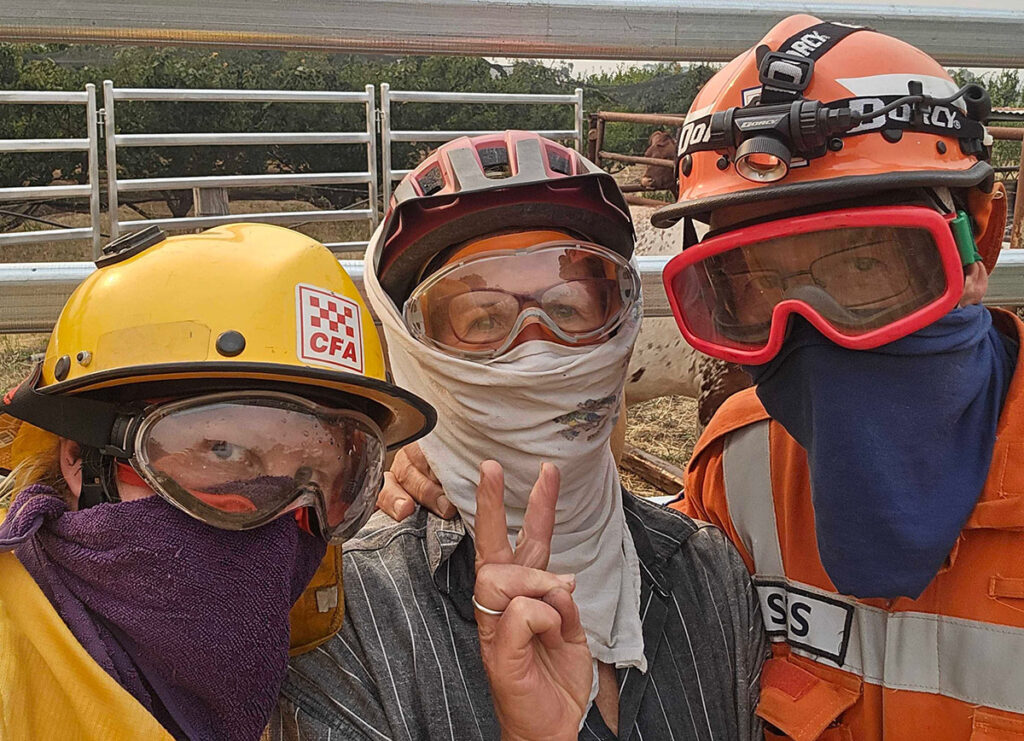
Stay safe, everyone. There are many people in our community hurting at the moment. Thankfully, there are also many incredible people out there putting their energy into stopping these fires, protecting people and houses, and looking after our community, without whom our farm would most definitely have been burnt. x